As your business grows, your technology becomes more complex. New cybersecurity risks emerge, employees rely on more cloud applications, compliance requirements increase, and your internal IT team is expected to manage everything without additional resources.
Many Australian businesses reach a point where hiring more in-house staff is expensive, but outsourcing the entire IT function does not make sense either. This is where co-managed IT services provide a practical solution.
Co-managed IT combines your existing IT team with the expertise, tools, and support of a managed services provider (MSP). Instead of replacing your internal staff, the provider works alongside them to improve efficiency, strengthen security, and reduce operational pressure.
For organisations with between 20 and 250 employees, co-managed IT often provides the flexibility needed to scale without increasing overheads.
What Are Co-Managed IT Services?
Co-managed IT services are a partnership between your internal IT team and an external managed IT provider.
Rather than handing over complete responsibility, you decide which IT functions remain in-house and which are managed externally.
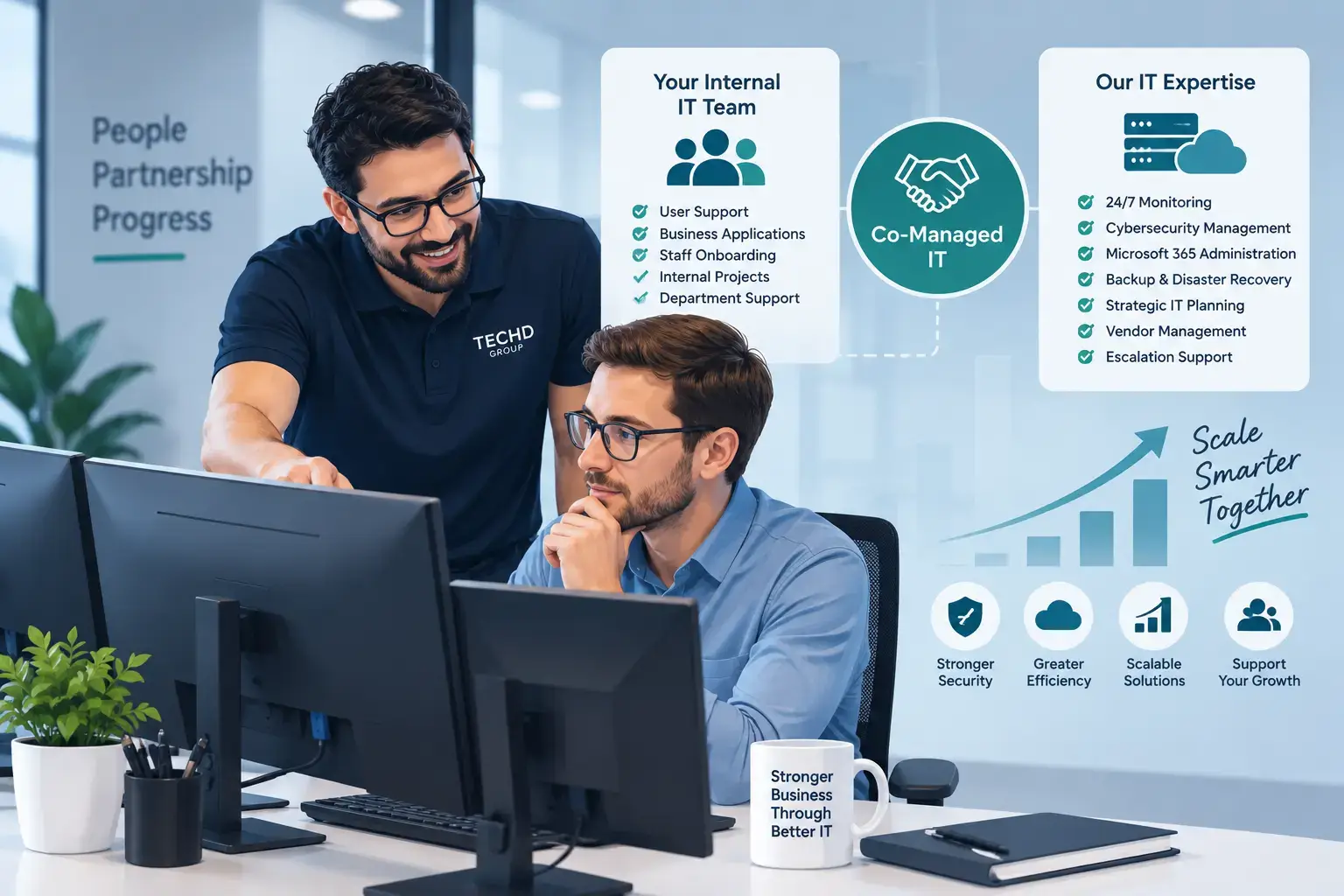
For example, your internal team may continue to handle:
- Day-to-day user support
- Business applications
- Staff onboarding
- Internal projects
- Department-specific technology
Meanwhile, your managed IT partner can assist with:
- 24/7 monitoring
- Cybersecurity management
- Microsoft 365 administration
- Infrastructure maintenance
- Backup and disaster recovery
- Strategic IT planning
- Vendor management
- Escalation support for complex issues
This shared responsibility gives businesses access to broader expertise without losing control over their technology.
If your organisation is already investing in internal IT resources, co-managed IT helps maximise that investment rather than replacing it.
How Does Co-Managed IT Work?
Every business has different technical requirements, so there is no single co-managed IT model.
A successful partnership begins by identifying responsibilities, service levels, and communication processes.
A typical arrangement may look like this.
| Internal IT Team | Managed IT Partner |
| End-user support | Infrastructure monitoring |
| Device deployment | Cybersecurity operations |
| Business software | Microsoft 365 management |
| Office technology | Backup management |
| Staff onboarding | Network management |
| Internal projects | Strategic IT planning |
| Department support | Escalation for complex incidents |
Both teams work together using shared documentation, service management tools, and agreed response procedures.
The result is a seamless experience for employees while reducing pressure on internal resources.
Why Businesses Choose Co-Managed IT
Many organisations initially build an internal IT department that successfully supports daily operations.
Over time, however, technology requirements evolve faster than internal resources.
Businesses often need expertise in areas such as:
- Advanced cybersecurity
- Microsoft 365 optimisation
- Cloud infrastructure
- Compliance frameworks
- Network security
- Business continuity planning
- Vendor management
Recruiting specialists across every discipline is costly and often unnecessary.
A co-managed IT model allows businesses to access these capabilities whenever required while maintaining their existing IT team.
This approach also helps internal staff focus on strategic initiatives instead of spending their time resolving repetitive support requests.
Signs Your Business Could Benefit From Co-Managed IT
Several indicators suggest your organisation has reached the point where additional IT support could deliver measurable value.
Your IT Team Is Constantly Busy
Internal IT teams often spend most of their day responding to helpdesk tickets.
Password resets, software installations, device troubleshooting, and user requests leave little time for strategic improvements.
A co-managed IT partner can handle routine operational tasks, allowing internal staff to concentrate on projects that improve productivity and support business growth.
Cybersecurity Is Becoming Difficult to Manage
Modern cyber threats require continuous monitoring and specialised knowledge.
Businesses now need capabilities such as:
- Endpoint detection and response
- Email security
- Identity protection
- Security monitoring
- Vulnerability management
- Multi-factor authentication
- Security awareness training
Maintaining these services internally requires significant investment in both technology and skilled personnel.
Working with a cybersecurity-focused managed IT provider provides access to these capabilities without expanding your internal team.
If strengthening your cyber resilience is a priority, our Cyber Security Services provide layered protection designed for Australian businesses.
Your Internal Team Lacks Specialist Skills
Technology changes rapidly.
Even highly capable IT professionals cannot specialise in every platform, cloud service, compliance framework, or security solution.
A co-managed IT partnership gives your business access to specialists across multiple disciplines whenever needed.
Instead of recruiting additional employees, you gain access to an entire technical team with experience supporting businesses across different industries.
Your Business Is Growing Faster Than Your IT Capability
Growth creates new technology demands.
Opening additional offices, hiring more employees, adopting cloud platforms, or expanding into new markets all increase the complexity of managing IT.
Without additional support, internal teams can quickly become overwhelmed.
A co-managed IT provider helps businesses scale by supplying additional technical resources when required, without the delays and costs associated with hiring permanent employees.
Compliance Requirements Continue to Increase
Many Australian businesses must comply with industry regulations, cyber insurance requirements, or security frameworks.
Depending on your industry, these may include:
- Essential Eight
- ISO 27001
- ACSC recommendations
- Privacy Act obligations
- Client security requirements
- Cyber insurance controls
Meeting these requirements requires ongoing monitoring, documentation, reporting, and regular security improvements.
A co-managed IT provider can assist your internal team with implementing and maintaining these controls while reducing compliance risks.
Learn more about TECHD Group’s Compliance Services if your business is preparing for audits or strengthening its security posture.
Benefits of Co-Managed IT Services
Choosing a co-managed IT model offers more than additional technical support. It creates a stronger foundation for business growth while allowing your existing IT staff to operate more effectively.
Access Specialist Expertise
Technology covers many specialist disciplines.
Instead of relying on one or two generalists, your business gains access to experts in:
- Cybersecurity
- Cloud infrastructure
- Microsoft 365
- Networking
- Business continuity
- Disaster recovery
- Identity management
- Infrastructure design
This broader knowledge reduces risk and improves decision-making.
Reduce Pressure on Internal IT Staff
IT professionals often spend most of their working week responding to reactive issues.
Routine requests interrupt project work and reduce productivity.
With a co-managed partner handling monitoring, maintenance, and escalated support, internal staff have more time to focus on:
- Digital transformation
- Process improvements
- User training
- Technology planning
- Business innovation
This leads to better outcomes for both employees and the wider organisation.
Improve Cybersecurity
Cybersecurity has become too complex for many internal IT teams to manage alone.
A managed services provider brings specialised security tools, experienced analysts, and proven processes that strengthen your overall security posture.
This typically includes:
- Continuous monitoring
- Threat detection
- Security patch management
- Email protection
- Multi-factor authentication
- Backup verification
- Incident response planning
Combined with your internal team’s business knowledge, this creates a stronger security strategy.
Predictable IT Costs
Recruiting experienced IT professionals is expensive.
Salary costs, training, certifications, recruitment fees, and employee benefits quickly add up.
Co-managed IT provides access to a larger technical team for a predictable monthly investment, allowing businesses to scale support without significantly increasing payroll.
Better Business Continuity
Internal IT teams can become vulnerable when key employees are unavailable.
Annual leave, illness, staff turnover, or unexpected resignations may leave critical systems unsupported.
A co-managed IT provider ensures knowledge, documentation, and support continue regardless of staffing changes.
This reduces operational risk while improving service continuity.
Co-Managed IT vs Fully Managed IT
Although the two models appear similar, they are designed for different business needs.
| Co-Managed IT | Fully Managed IT |
| Internal IT team remains in place | Provider manages all IT operations |
| Shared responsibilities | Full outsourcing of IT |
| Supports existing staff | Replaces internal IT resources where appropriate |
| Flexible service scope | Comprehensive managed service |
| Suitable for businesses with internal IT capability | Suitable for businesses without an internal IT department |
Businesses with established IT teams generally benefit from co-managed services because they retain internal knowledge while expanding technical capability.
Organisations without dedicated IT staff often achieve better outcomes through a fully managed IT service.
If your business is evaluating outsourced IT support, explore our Managed IT Services to understand how fully managed support differs from a co-managed approach.
How to Choose the Right Co-Managed IT Provider
Not every managed service provider offers effective co-managed IT services.
When evaluating providers, ask the following questions.
Do They Work Collaboratively?
A good partner strengthens your existing IT team instead of taking control away from them.
Look for providers that value collaboration, transparency, and shared decision-making.
Do They Offer Flexible Support?
Every organisation has different requirements.
Choose a provider that allows you to decide which services remain internal and which are outsourced.
Avoid providers that insist on replacing your entire IT function.
Do They Provide Strategic Guidance?
Technology should support business objectives.
An experienced co-managed IT partner should help your organisation with:
- Technology roadmaps
- Infrastructure planning
- Budget forecasting
- Risk management
- Cloud strategy
- Business continuity planning
Strategic guidance ensures technology investments continue delivering long-term value.
Can They Scale With Your Business?
Your IT requirements today may look very different in two years.
Select a provider capable of supporting business growth, additional locations, larger workforces, and changing security requirements without disrupting operations.
Do They Deliver Responsive Support?
Response times matter when technology issues affect productivity.
Your provider should offer clearly defined service levels, proactive communication, and access to experienced engineers whenever assistance is required.
For organisations requiring additional operational support, TECHD Group also provides dedicated IT Help Desk Support to help resolve technical issues quickly and efficiently.
Is Co-Managed IT Right for Your Business?
Co-managed IT is not about replacing your internal IT department. It is about giving your team the additional expertise, resources, and capacity they need to support a growing business.
If your organisation is experiencing increasing cybersecurity demands, expanding operations, or struggling to balance daily support with strategic projects, a co-managed approach can help your IT team deliver better outcomes without increasing headcount.
By combining internal knowledge with external specialists, businesses gain a flexible IT model that improves resilience, strengthens security, and supports long-term growth.
At TECHD Group, we work alongside internal IT teams to provide the technical expertise, proactive support, and strategic guidance needed to help Australian businesses stay secure, productive, and ready for what’s next.
If you’re exploring whether co-managed IT is the right fit, contact TECHD Group to discuss your current environment and discover how a tailored partnership can support your business goals.
Frequently Asked Questions
What Is the Difference Between Co-Managed IT and Managed IT Services?
Co-managed IT supports your existing internal IT team by sharing responsibilities with an external provider. Managed IT services involve outsourcing most or all of your IT operations to a managed services provider.
Is Co-Managed IT Suitable for Small Businesses?
Co-managed IT is most beneficial for businesses that already have one or more internal IT employees but require additional expertise or resources. Businesses without an internal IT team may benefit more from fully managed IT services.
Can We Choose Which IT Services Are Outsourced?
Yes. One of the key advantages of co-managed IT is flexibility. Your business decides which responsibilities remain with your internal team and which services are handled by your managed IT provider.
Does Co-Managed IT Improve Cybersecurity?
Yes. A co-managed IT provider can strengthen your cybersecurity by providing continuous monitoring, threat detection, security updates, backup management, Microsoft 365 security, and specialist expertise that complements your internal team.
Will Co-Managed IT Replace Our Internal IT Staff?
No. The goal is to support and strengthen your existing IT team rather than replace it. Internal staff retain ownership of business knowledge while benefiting from additional technical expertise and operational support.
How Do I Know If My Business Needs Co-Managed IT?
Your business may benefit from co-managed IT if your IT team is overloaded, cybersecurity demands are increasing, major technology projects are being delayed, or you need specialist expertise without hiring additional employees.